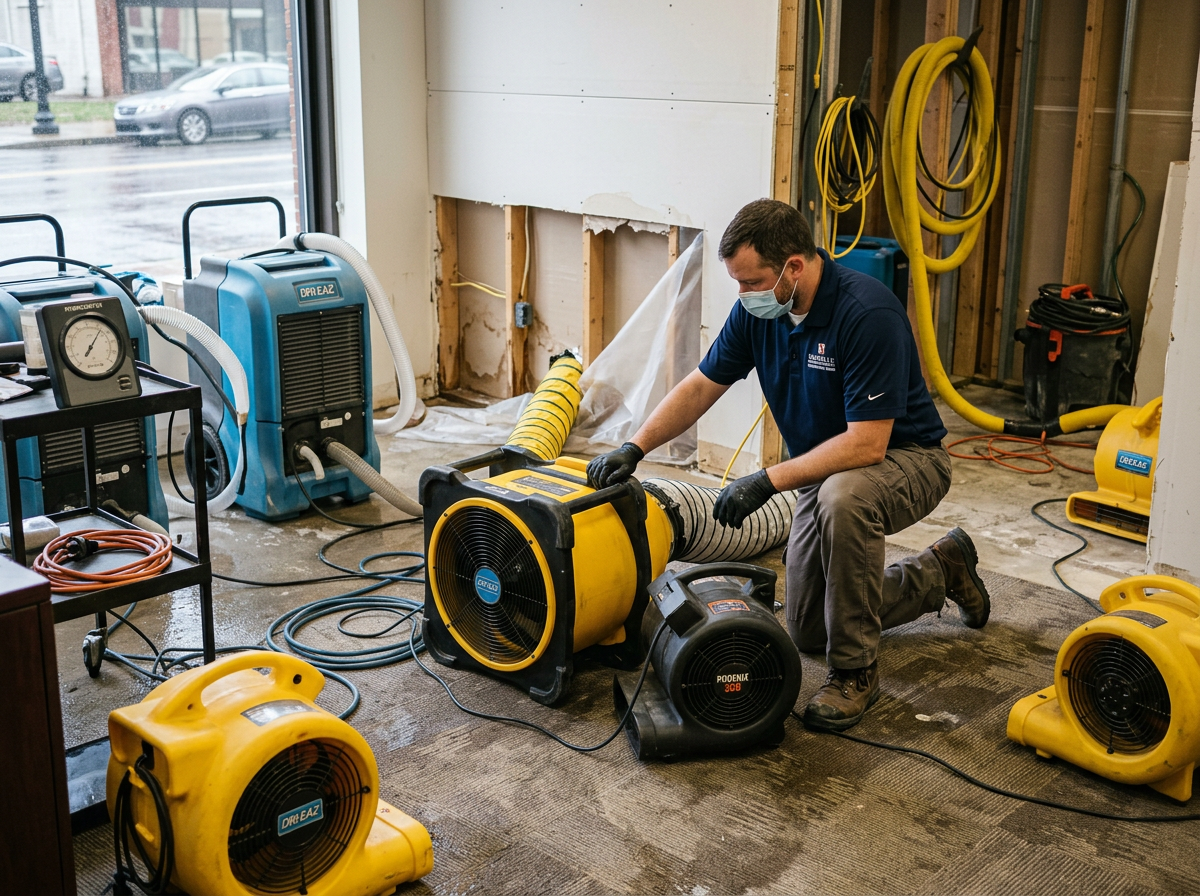
Nashville’s humid subtropical climate keeps relative humidity high from late spring through early fall, which slows evaporation from slab foundations in older Davidson County homes. In neighborhoods such as East Nashville and Germantown, many residences built before 1960 have post-tension slabs and hardwood floors that trap water along joist pockets; without aggressive extraction and dehumidification, residual moisture migrates into subflooring and wall cavities within days. Technicians must account for the clay-heavy soils common around the Cumberland River that hold water against the slab edge, extending drying times compared with drier inland counties.
After a slab leak is located and isolated, the drying sequence begins with moisture mapping using penetrating and non-penetrating meters to chart affected zones in concrete and adjacent framing. Industrial desiccant or LGR dehumidifiers are positioned to create negative pressure gradients that pull moist air out of wall cavities and under cabinets, while air movers are angled across flooring to disrupt the boundary layer. In homes near Centennial Park or The Gulch with limited crawl-space access, temporary penetrations through baseboards are sometimes required; these openings are later sealed to code. Failure to reach sub-1 % moisture content before reinstalling finishes frequently leads to cupping or microbial growth weeks later.
Edge cases arise in Belle Meade and Green Hills properties where finished basements sit below grade; hydrostatic pressure can re-wet slabs even after the leak is repaired. Technicians monitor daily with data-logging meters and adjust equipment placement rather than relying on a fixed timeline. Homeowners are advised against running household fans alone, as they recirculate humid air and can spread spores into HVAC returns serving multiple rooms.
Technician insight
In Nashville the thing that catches most people out with structural drying is how quickly our summer humidity re-wets a slab once the dehumidifiers are pulled; older East Nashville homes with original oak floors over post-tension slabs often need an extra day of equipment because the clay soil along the foundation keeps feeding moisture back into the concrete.
East Nashville Hardwood Cupping
A homeowner in East Nashville noticed floors buckling near the kitchen after a slab leak was repaired. Mapping showed moisture trapped under the subfloor extending into two adjacent rooms. Desiccant units and air movers ran for four days while daily readings guided repositioning around the slab edge. Final verification confirmed safe levels and the floors flattened without replacement.
Structural Drying Services We Offer
✓Moisture Mapping and Assessment
Pinpoint hidden water pockets in slabs, subfloors, and walls using calibrated meters before equipment placement.
✓Industrial Dehumidification
Deploy LGR and desiccant units sized for Nashville humidity loads to pull moisture from concrete and framing.
✓Targeted Air Circulation
Position air movers to create directed airflow across flooring and into wall cavities without spreading contaminants.
✓Post-Drying Verification
Document moisture levels daily until readings stabilize, then provide written verification before finishes are restored.
✓Crawl Space and Slab Edge Drying
Address moisture trapped against foundation walls in older Donelson and West End homes where clay soils retain water.
Structural Drying Cost in Tennessee
| Service | Typical Range | What Affects It |
|---|---|---|
| Single-room slab drying | $900–$1,600 | One to three days; common in smaller Germantown homes |
| Multi-room or basement drying | $1,800–$3,200 | Four-plus days; typical after leaks near West End or Green Hills |
| Daily equipment rental extension | $150–$250 | Added when humidity spikes keep readings elevated |
| Crawl-space or slab-edge add-on | $400–$700 | Required in older Donelson properties with exterior water intrusion |
Ranges are typical for Tennessee and confirmed with an exact written quote before any work starts.
How it works
- 1
Site Evaluation
Meter every affected surface and identify HVAC pathways that could spread moisture.
- 2
Equipment Setup
Place dehumidifiers and air movers, seal off rooms, and establish daily monitoring points.
- 3
Daily Adjustments
Read meters, reposition equipment, and track humidity until target levels are sustained.
- 4
Final Verification
Confirm subfloor and slab moisture content, then document results for the homeowner.
Pricing
Upfront quotes after inspection; price driven by square footage, depth of water migration, and number of days required.