Nashville homes built before 1970 in East Nashville and Germantown often sit on clay-heavy soils that expand and contract with the area's humid subtropical weather. Hot summers drive pipe expansion while cool winters and occasional freezes create contraction stress points under slabs. Detection crews must account for these cycles when tracing leaks near Centennial Park or The Gulch, where older plumbing runs can shift against concrete without visible surface clues.
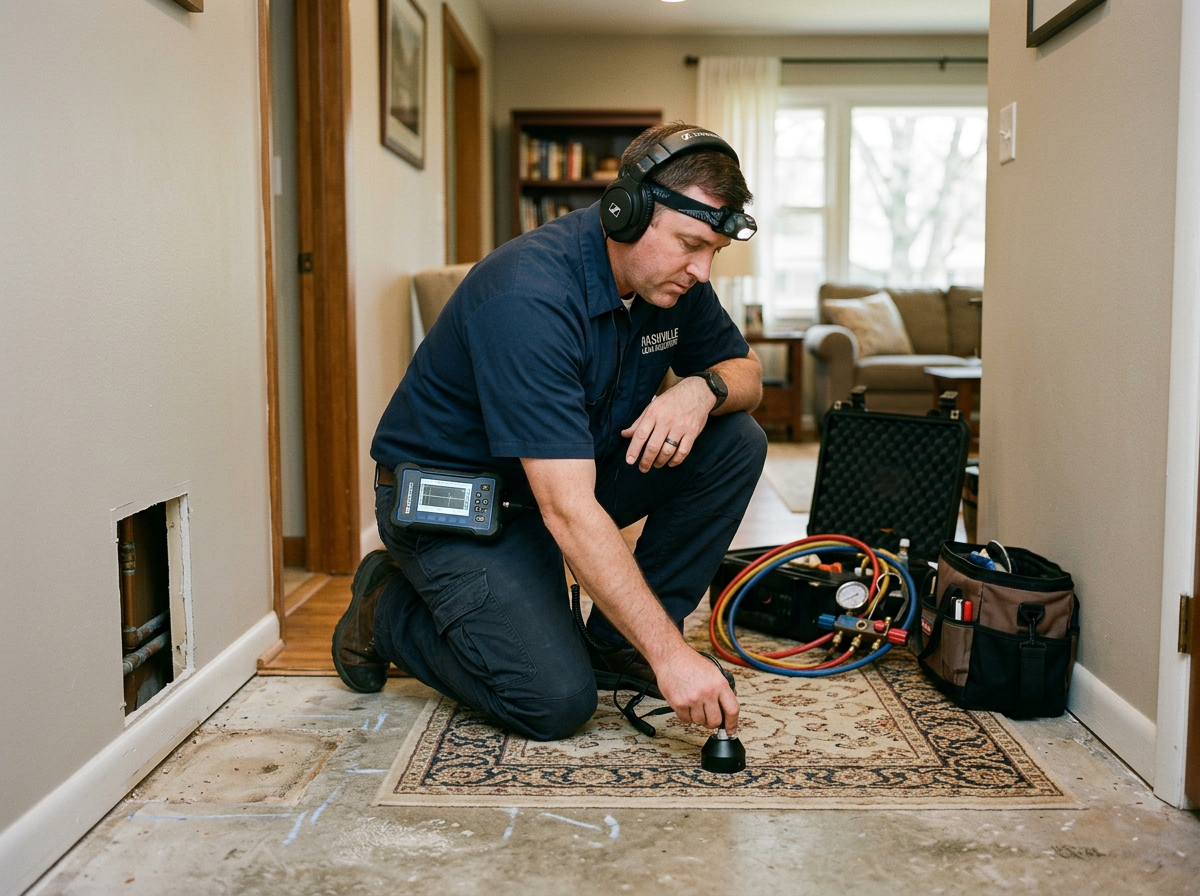
Electronic leak detection works best on Davidson County properties because it locates moisture without breaking slabs, a critical advantage in tight lots around Bridgestone Arena or dense West End blocks. Acoustic listening picks up flow sounds through concrete but struggles near Ryman Auditorium traffic noise, so technicians combine it with pressure testing on copper or galvanized lines common in Belle Meade and Donelson. Thermal imaging reveals temperature differentials caused by evaporative cooling under slabs during humid months.
Homeowners in Green Hills frequently mistake slab leaks for irrigation issues because both produce similar yard dampness. Proper detection requires isolating the main line and checking for pressure drops that persist after sprinklers are shut off. Soil conductivity changes after heavy spring rains also affect signal strength on electronic equipment, forcing crews to adjust sensitivity when working near Parthenon-area foundations.
Technician insight
In Nashville the thing that catches most people out with slab leak detection is how clay soils around Donelson and Green Hills hold moisture after summer storms, making electronic signals weaker until the ground dries. Homeowners often assume a high water bill means a simple fixture leak, but in pre-1960 homes the real issue is usually a pinhole in galvanized lines that only shows up once we isolate the slab.
East Nashville 1950s Bungalow
Rising water bills appeared after spring rains with no visible wet spots. Pressure testing ruled out irrigation, then acoustic listening located flow under the rear slab near shifting clay. A small core confirmed the leak on an original galvanized line; repair access was limited to one 18-inch opening.
Slab Leak Detection Services We Offer
✓Electronic Leak Detection
Uses frequency-based sensors to pinpoint leaks under slabs without excavation, ideal for older East Nashville and Germantown homes where digging risks damaging surrounding utilities.
✓Acoustic Listening Surveys
Amplifies water flow sounds through concrete to locate leaks in high-traffic zones like Downtown and The Gulch where ambient noise requires specialized filtering.
✓Pressure Testing and Isolation
Segments plumbing systems to confirm leak presence and rule out irrigation or fixture problems common after Davidson County rains.
✓Thermal Imaging Scans
Detects cool spots from evaporating water under slabs during humid summers, useful in Belle Meade and Donelson where surface clues are minimal.
✓Moisture Mapping
Creates a grid of subsurface moisture readings to guide targeted access points and avoid unnecessary concrete removal in dense Green Hills lots.
Slab Leak Detection Cost in Tennessee
| Service | Typical Range | What Affects It |
|---|---|---|
| Basic Electronic Detection | $275–$450 | Single-story homes with clear access; rises in multi-story or landscaped properties. |
| Acoustic Plus Pressure Testing | $350–$550 | Older plumbing in East Nashville or Germantown where noise interference is present. |
| Thermal Imaging Add-On | $150–$250 | Useful after heavy rains when soil moisture masks standard readings. |
Ranges are typical for Tennessee and confirmed with an exact written quote before any work starts.
How it works
- 1
Initial Assessment
Review water bill history and visible signs, then isolate the slab system from irrigation and fixtures.
- 2
Tool Selection
Choose electronic or acoustic methods based on soil type, home age, and neighborhood noise levels.
- 3
Systematic Scanning
Map moisture or sound patterns across the slab while adjusting for seasonal humidity and clay expansion.
- 4
Verification
Confirm findings with pressure tests or small core samples before recommending repair access points.
Pricing
Detection pricing varies with home age, lot access, and whether multiple methods are required.